Skip to content

Demonstration site. Blueprint Mechanical is not a real contractor. Licence number, phone numbers and address are placeholders.

MECH-04

Condensing plant, designed around the return water temperature

A condensing boiler only condenses when the water coming back to it is cold enough. Plenty of buildings on the Front Range have a 95 percent efficient boiler running at 85 percent because nobody designed the return side.

At a glance

Reference
MECH-04
Typical programme
6 to 16 weeks depending on plant size
Sector
Commercial and residential
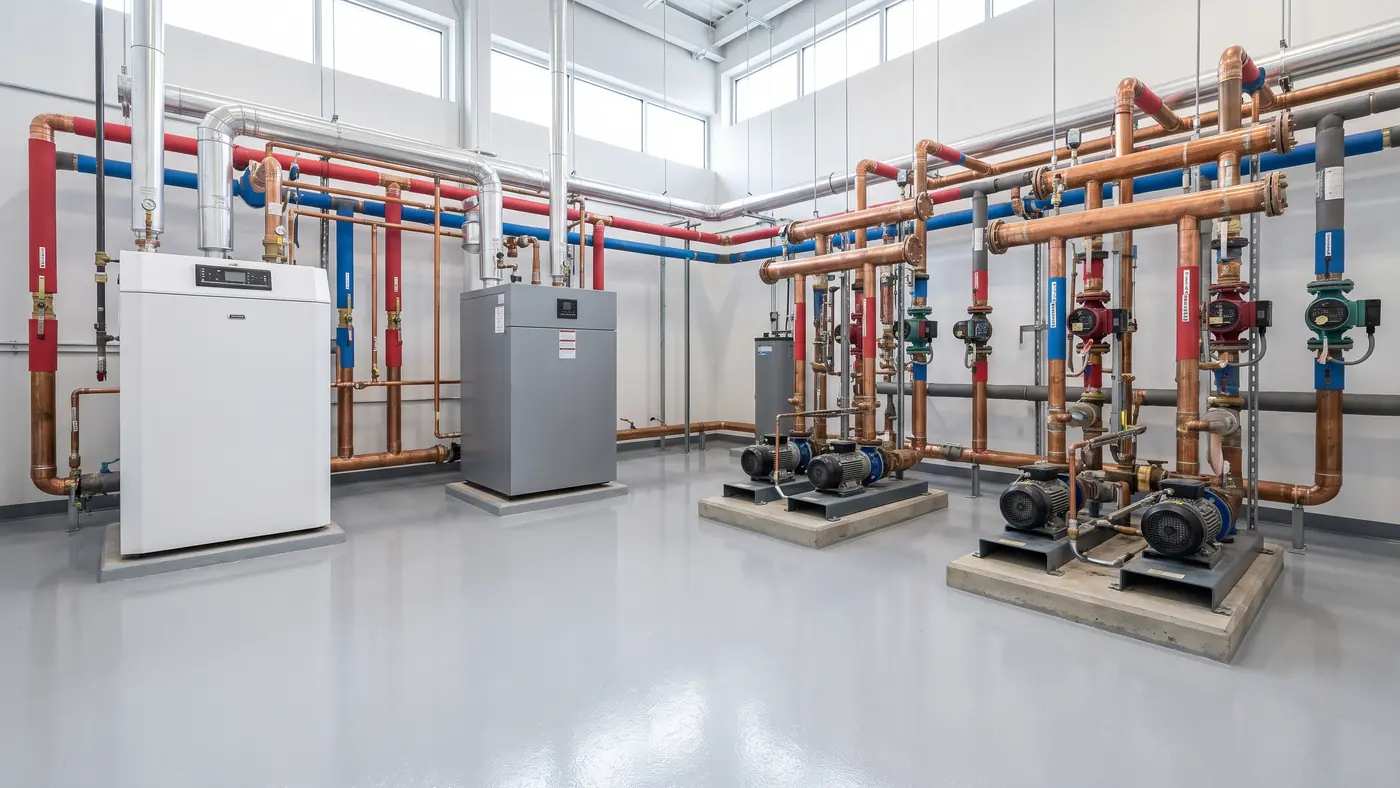
A clean commercial mechanical room with two condensing boilers, copper and steel hydronic headers, circulator pumps and colour-coded pipe insulation
Primary and secondary headers, labelled, with the pumps on inertia bases.

Return water temperature is the design variable

A condensing boiler recovers latent heat from the flue gas by condensing water vapour out of it. That only happens when the heat exchanger surface is below the dew point of the combustion products, which in practice means return water below about 130 °F, and efficiency keeps climbing as it falls further.

So the design question is not which boiler, it is what the return water temperature will be across the season. A system built around 180 °F supply and a 20 °F drop returns water at 160 °F and never condenses. The same building on a lower-temperature emitter with a properly configured outdoor reset can spend most of the season below 120 °F.

That usually means larger emitters, or radiant, or both. It is a distribution decision dressed up as a plant decision.

Modulation range matters more than peak output

Boilers are sized for a design day that occurs a handful of hours a year. For the rest of the season the plant is at part load, and what determines efficiency there is turndown.

A 10 to 1 boiler can follow the load down to 10 percent before it starts cycling. Two smaller boilers in a lead-lag arrangement extend that further and give you redundancy. Four boilers where two would do is an equipment-supplier answer rather than an engineering one.

We size for the calculated load, check the modulation range against the load profile, and stage the plant so it does not short cycle in October.

Radiant, where the slab makes it possible

In-slab radiant is usually ruled out by the cost of the concrete rather than the cost of the tubing. Where a slab is being poured or replaced anyway, as it was on the Aurora warehouse, the economics change completely.

A slab at 105 °F supply with a 20 °F drop returns water at 85 °F, which keeps a condensing boiler in condensing mode essentially all season. It also solves stratification in tall spaces: the Aurora building went from 14 °F of vertical stratification to under 3 °F at the working floor.

Loop layout, tube spacing and manifold balancing are all design decisions with consequences. We draw the loops, state the spacing, and balance the manifold with flow meters rather than by ear.

High-altitude derate, confirmed with a combustion analyser

Gas equipment installed above 2,000 ft has to be derated and, on most non-condensing and many condensing appliances, fitted with the manufacturer high-altitude kit, which usually means different orifices.

A common rule is roughly 4 percent less input per 1,000 ft above 2,000 ft, but the number that matters is the one in the specific manufacturer listing, so that is the one we work to.

At startup we run a combustion analysis and give you the printout: O2 or CO2, CO, stack temperature and calculated efficiency. It goes in the handover file, and we repeat it at the first annual service so there is a trend rather than a single reading.

Diurnal swing is what breaks a fixed setpoint

A 30 to 40 °F swing between a Denver night and the following afternoon is normal. Plants running a fixed supply temperature overshoot badly on the afternoon side of that, which is why outdoor reset is not an optional refinement here. We set the curve, then trend it and adjust it after the first month of real weather.

Questions we get about this.

If yours is not here, ask it directly. You get an answer from the engineer who would run the job, not from a call centre.

All questions
Will a heat pump actually work through a Denver winter?

A properly selected cold-climate heat pump will, and we will show you the number rather than assert it.

The Denver 99.6 percent heating design condition is about 1 F. A modern variable-capacity cold-climate heat pump typically holds 70 to 80 percent of its nominal heating capacity at that temperature. We select on capacity at the design temperature, not at the 47 F rating point, and we calculate the balance point where the heat pump output crosses the building load.

For most well-insulated Denver homes that balance point lands between 5 F and 20 F. Below it you need supplemental heat, and how much depends on your house. We size the supplement to the gap, which is usually far less than a full backup furnace.

What is TAB, and why is it a separate line on your proposal?

TAB is testing, adjusting and balancing. Airflows and water flows are measured against the design, dampers and valves are adjusted until they match, and the results are recorded.

It is a separate line because it is separate work, and because listing it separately makes it harder to quietly delete. A system that was designed correctly and installed correctly still does not perform correctly until it has been balanced.

You get a TAB report with the design value and the measured value side by side for every terminal. Where a terminal is out of tolerance, the report says so and says what was done about it.

Related work

Ask us about boilers and radiant.

Send us the building, the equipment and the complaint. You get a written response with the load we would run, what we would measure first, and a range before anyone visits.

Or call (303) 555-0148. Mon to Fri 07:00 to 17:00.