Skip to content

Demonstration site. Blueprint Mechanical is not a real contractor. Licence number, phone numbers and address are placeholders.

MECH-03

VRF, but only where the zoning genuinely earns it

Variable refrigerant flow is excellent at one specific thing: moving heat from a zone that has too much to a zone that does not have enough. If your building does not do that for enough hours a year, we will tell you to buy something cheaper.

At a glance

Reference
MECH-03
Typical programme
10 to 20 weeks, design through startup
Sector
Commercial
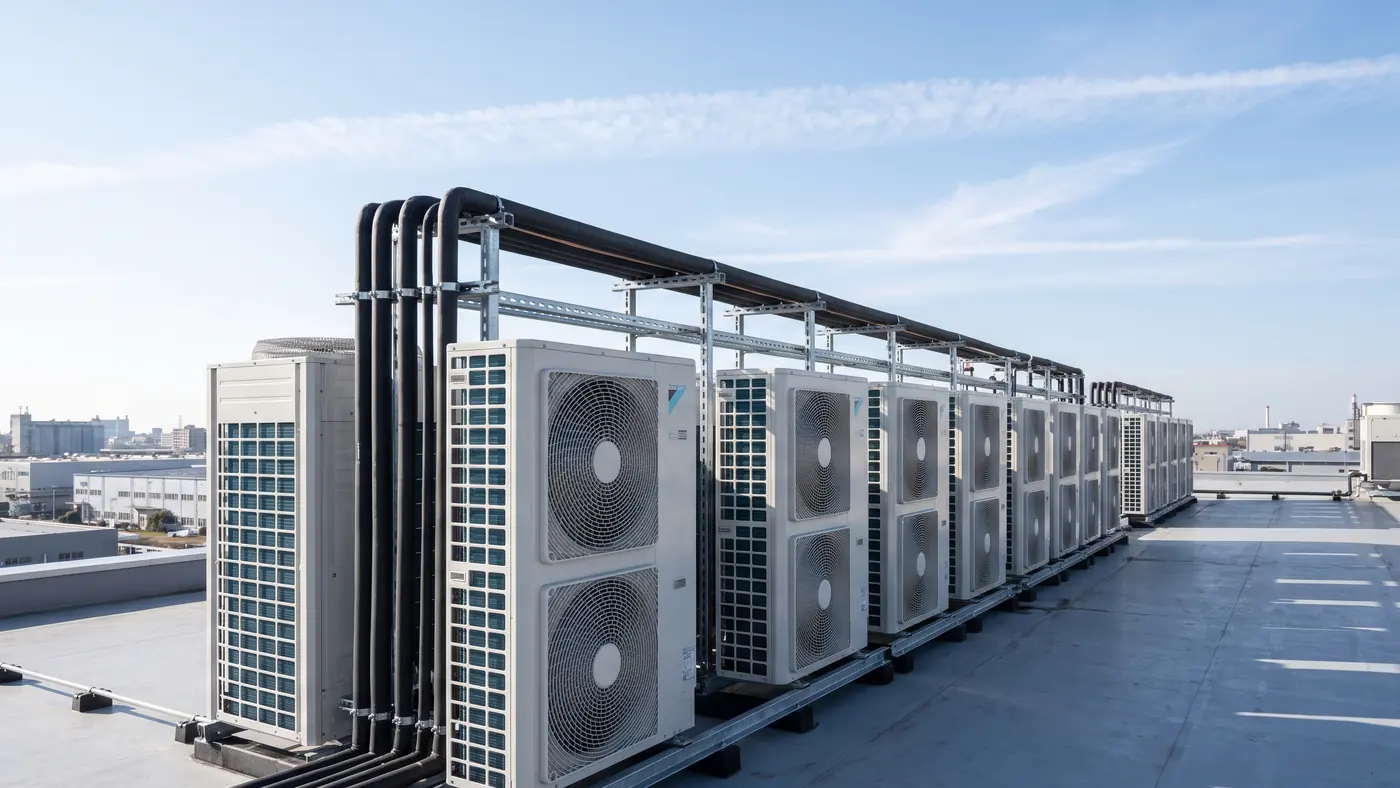
A row of white modular VRF outdoor condensing units with neatly racked and insulated refrigerant line sets on a flat commercial roof
Four heat recovery systems, 122 tons, serving 19 zones.

Count the simultaneous hours before you buy heat recovery

Heat recovery VRF costs meaningfully more than a heat pump VRF, and it only pays back where heating and cooling are genuinely called for at the same time. On the Boulder laboratory we counted about 5.5 hours a day of simultaneous demand across the shoulder seasons, driven by instrument rooms rejecting heat while perimeter offices asked for it.

That is a clear case. A speculative office floor with a uniform load profile is not, and we have talked clients out of three-pipe systems more than once.

The zone-by-zone load calculation is what settles it. It is the same work either way, so we do it before recommending the system rather than after.

Separate ventilation from conditioning

The most common VRF design mistake we see is using the indoor units to bring in outdoor air. It couples ventilation to a thermostat call, which means a zone that needs air only gets it when it also wants conditioning.

We put ventilation on a dedicated outdoor air unit with energy recovery, delivering neutral air at the ASHRAE 62.1 ventilation rate procedure quantity. The VRF then does space conditioning only, which is what it is good at, and the outdoor air rate can be trended and proved.

In Denver the energy recovery wheel or core also does useful work on humidity, in the opposite direction to most of the country: our air is dry enough that winter humidification is often the real problem.

Refrigerant concentration limits are a calculation, not a formality

A VRF system holds a very large refrigerant charge, and ASHRAE 15 sets a limit on how much of it may be released into the smallest occupied space a branch serves. With R-454B, an A2L, the limits and the mitigation requirements under UL 60335-2-40 are stricter again.

We calculate the refrigerant concentration limit for every occupied space against the charge of the branch that serves it. On the Boulder job two small instrument rooms failed on the first pass, so we resplit the branch. The alternative, reinterpreting the calculation, is not an engineering decision.

Where mitigation is needed, it gets designed in: detection, interlocks and the ventilation rate to clear the space, all on the drawings rather than added on site.

Capacity at 1 °F, not at 47 °F

A VRF outdoor unit rated at 30 tons is rated at 47 °F ambient. What matters in Colorado is what it produces at the 99.6 percent heating design condition, which is about 1 °F on the Front Range.

Modern cold-climate VRF holds roughly 70 to 80 percent of nominal heating capacity at that temperature, with defrost losses on top. We select on that figure, calculate the balance point where output crosses the building load, and size any supplement to the gap rather than installing a full backup plant out of caution.

Dry air changes the humidity argument

Most VRF guidance is written for humid climates, where latent capacity and dehumidification dominate the conversation. On the Front Range the binding problem is usually the opposite: winter air so dry that occupants complain, and equipment selections that assume a latent load which is not there.

Questions we get about this.

If yours is not here, ask it directly. You get an answer from the engineer who would run the job, not from a call centre.

All questions
Will a heat pump actually work through a Denver winter?

A properly selected cold-climate heat pump will, and we will show you the number rather than assert it.

The Denver 99.6 percent heating design condition is about 1 F. A modern variable-capacity cold-climate heat pump typically holds 70 to 80 percent of its nominal heating capacity at that temperature. We select on capacity at the design temperature, not at the 47 F rating point, and we calculate the balance point where the heat pump output crosses the building load.

For most well-insulated Denver homes that balance point lands between 5 F and 20 F. Below it you need supplemental heat, and how much depends on your house. We size the supplement to the gap, which is usually far less than a full backup furnace.

What does the move from R-410A to R-454B mean for equipment I buy now?

R-454B has a global warming potential of about 466, against roughly 2,088 for R-410A, which is why the AIM Act phase-down moved new equipment manufacture onto it.

R-454B is an A2L, which means mildly flammable. Practically that changes charge limits per occupied space, requires refrigerant detection and mitigation on some indoor equipment under UL 60335-2-40, and changes some service procedures. It does not make the equipment exotic or hard to maintain.

Existing R-410A systems are not illegal and do not need replacing. Reclaimed and stockpiled R-410A remains available for service. We will tell you plainly whether a repair or a replacement is the better spend on your specific unit.

Related work

Ask us about vrf systems.

Send us the building, the equipment and the complaint. You get a written response with the load we would run, what we would measure first, and a range before anyone visits.

Or call (303) 555-0148. Mon to Fri 07:00 to 17:00.