Skip to content

Demonstration site. Blueprint Mechanical is not a real contractor. Licence number, phone numbers and address are placeholders.

MECH-05

Ductwork designed to a friction rate, fabricated to the drawing

If the equipment is right and the comfort is wrong, the distribution is the suspect. Duct design is the least glamorous part of this trade and the part that decides whether anything else works.

At a glance

Reference
MECH-05
Typical programme
2 to 8 weeks including fabrication
Sector
Commercial and residential
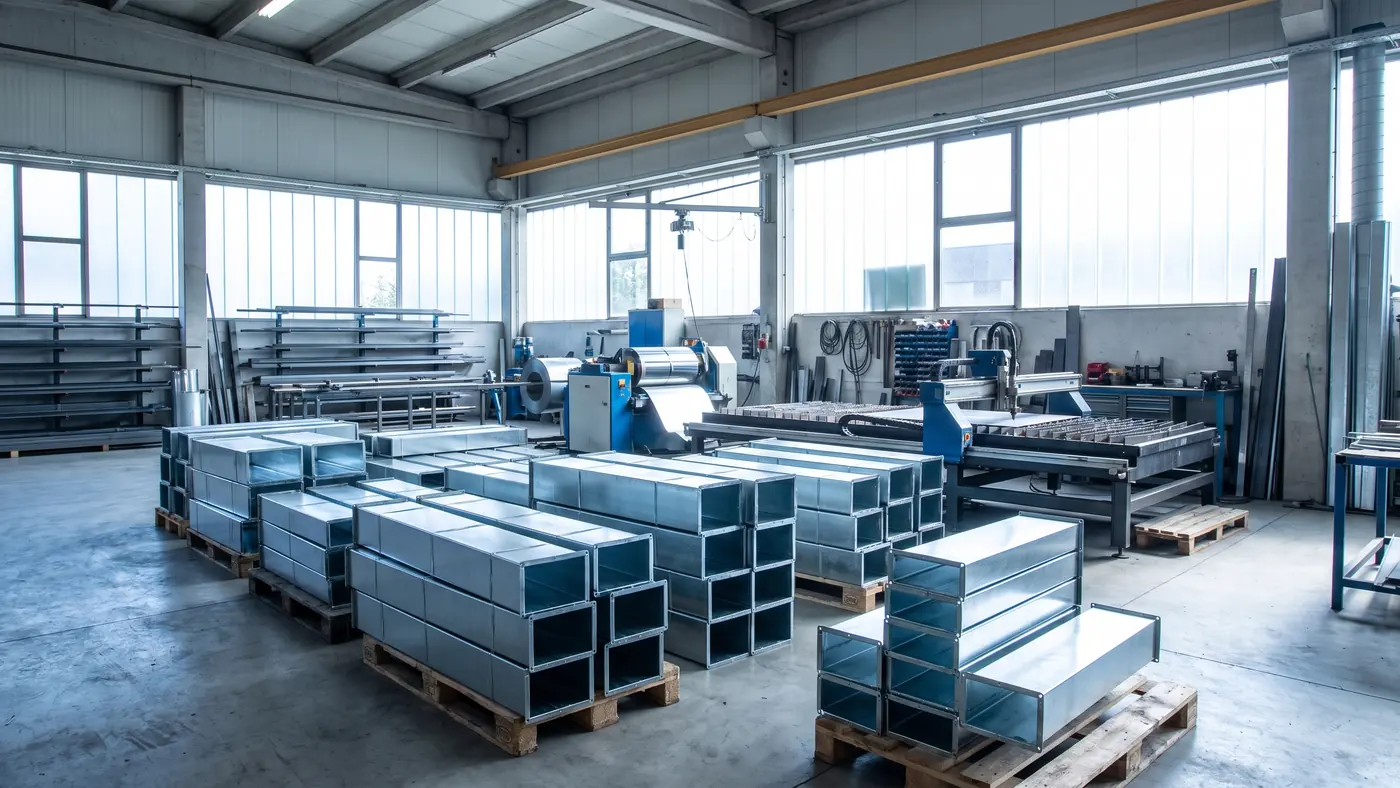
An HVAC sheet metal fabrication shop with a coil line, a plasma cutting table and freshly formed galvanized duct sections stacked in rows
Our shop. Fittings are cut to the drawing rather than adapted on the roof.

Derive the friction rate, do not inherit it

The available static pressure is what the equipment can deliver minus everything that is not duct: the coil, the filter, the balancing dampers, the grilles and the accessories. Divide what is left by the total effective length of the worst run and you have the friction rate the system can afford.

That number is frequently 0.05 or 0.06 in. w.c. per 100 ft, not the 0.10 that gets used by default. Designing to 0.10 anyway produces ducts that are too small, which is the single most common cause of a brand new system measuring 1.1 in. w.c. against a 0.5 in. w.c. rating.

Total effective length is the other half of it. A fitting has an equivalent length, sometimes a very large one. We count them, record the total, and put it on the drawing so anyone can check the arithmetic later.

The return path is where the pressure actually goes

On residential work in particular, supply ducts get designed and returns get whatever is left. One central return grille serving an entire house is a restriction with a floor plan around it.

The first thing we measure on a comfort complaint is total external static pressure, split across the return side and the supply side, so we can see which half is the problem. It is the return more often than not.

Adding a return path, correcting a filter rack, or replacing two badly chosen fittings is usually cheaper than any equipment change and fixes more.

Fabricated here, sealed to a stated class, tested

We run our own coil line and plasma table. That means the transition on the drawing is the transition that arrives on site, rather than a stock fitting plus a bit of adaptation at height.

Gauge, reinforcement and seal class follow SMACNA for the pressure class the system runs at. Where the specification calls for a leakage class, we test against it and give you the result rather than an assurance.

At startup we measure total external static pressure again and put the number in the handover file. Design intent and measured reality on the same page is the whole point.

Filters: MERV 13, in a rack big enough for it

A four-inch MERV 13 in a properly sized rack generally has a lower pressure drop than the one-inch MERV 8 it replaces, because media area matters more than nominal rating. A one-inch MERV 13 in a rack designed for MERV 8 is a throttle.

HEPA belongs in a dedicated recirculating unit with its own fan, not in a duct served by an air handler that cannot overcome it. We will say so plainly rather than fit it and let the airflow collapse.

Thin air needs more of it

At 5,280 ft the same duct carries the same volume but less mass, so the airflow a system needs in actual cfm is higher than the sea-level figure for the same capacity. Duct sized from sea-level airflow tables is undersized here before anyone has made a single fitting mistake.

Questions we get about this.

If yours is not here, ask it directly. You get an answer from the engineer who would run the job, not from a call centre.

All questions
My system is new but the house is uneven. Is that a duct problem?

Usually, yes. Roughly speaking, if the equipment is right and the comfort is wrong, the distribution is the suspect.

The first measurement we take is total external static pressure. Most residential air handlers are rated at 0.5 in. w.c. We routinely measure 0.9 to 1.2 in. w.c. on systems that were installed last year. That means the blower is not delivering rated airflow, which shows up as one room that never gets there.

The fix is usually a return path, a filter rack, or two or three fittings with a bad equivalent length, not a bigger blower. We measure, we show you the readings, and then we design the correction to a friction rate.

Should I put a HEPA filter in my system?

Almost certainly not directly in the duct. A true HEPA filter removes 99.97 percent of 0.3 micron particles, and it does that by presenting a pressure drop that a normal residential or commercial air handler cannot overcome.

For nearly all buildings the right answer is MERV 13 in a properly sized filter rack with enough media area to keep the pressure drop low, which is what ASHRAE recommends for general indoor air quality. A four-inch MERV 13 in a deep rack usually has a lower pressure drop than the one-inch MERV 8 it replaces.

If you genuinely need HEPA, for a clean space or a specific process, it goes in a dedicated recirculating unit designed around it, with its own fan.

Related work

Ask us about ductwork engineering.

Send us the building, the equipment and the complaint. You get a written response with the load we would run, what we would measure first, and a range before anyone visits.

Or call (303) 555-0148. Mon to Fri 07:00 to 17:00.