Regulation
R-410A to R-454B: what actually changes for building owners
The refrigerant on the nameplate changed. Most of the questions we get about it have simple answers, and one of them is that your existing system is fine.
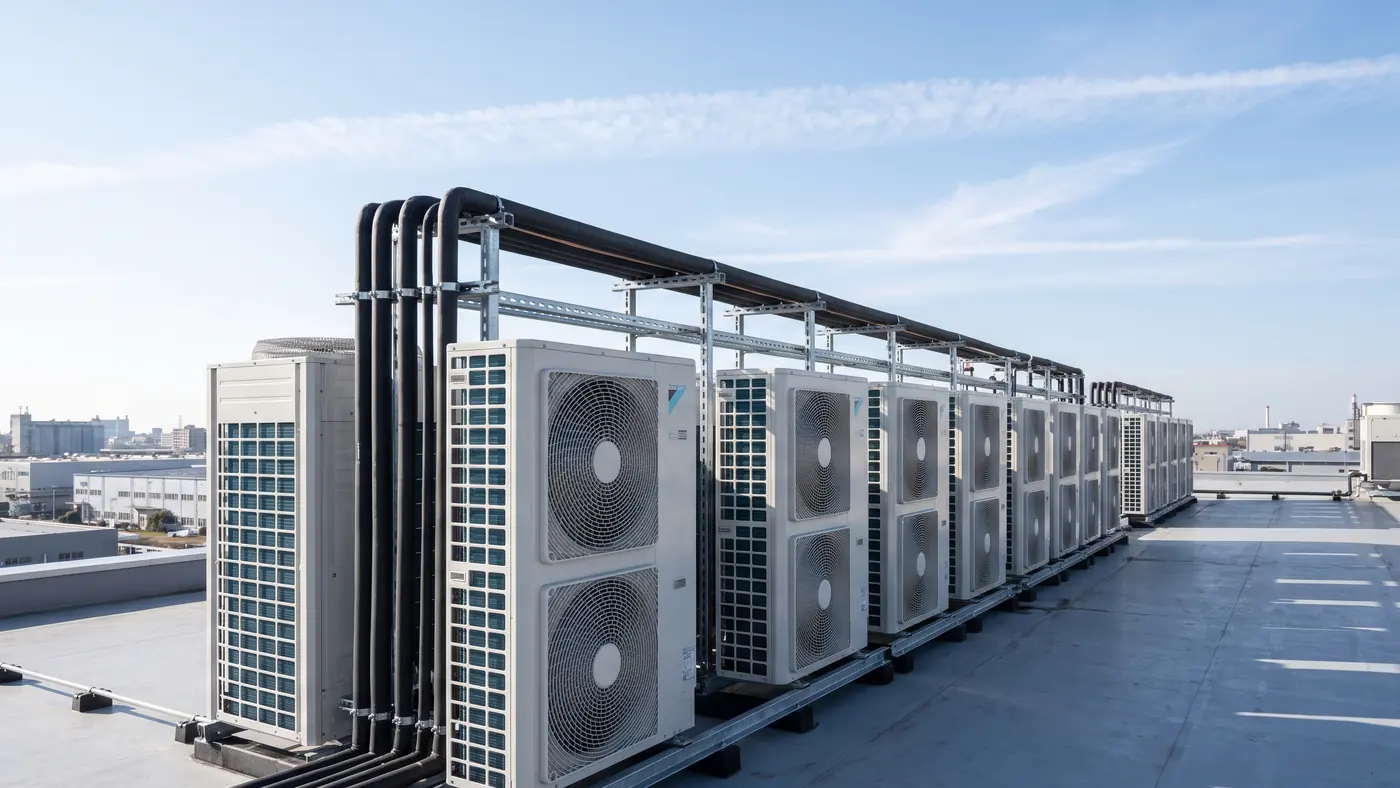
Since the AIM Act phase-down took effect for new equipment manufacture, most of the packaged and split equipment we install arrives charged with R-454B instead of R-410A. Building owners ask us about it constantly, usually in the form of a worry, and usually the answer is calmer than the question.
Here is what changes, what does not, and what is worth thinking about.
Why it changed
R-410A has a global warming potential of roughly 2,088. R-454B is about 466. That is the whole reason. The AIM Act sets a stepped-down cap on the production and import of high-GWP HFCs, and equipment manufacturers moved to lower-GWP blends to stay inside it.
R-454B is a blend of R-32 and R-1234yf. It has thermodynamic behaviour close enough to R-410A that equipment designs did not have to be reinvented, which is exactly why it was chosen.
What "A2L" means, in practical terms
R-454B is classified A2L: low toxicity, mildly flammable. "Mildly flammable" is a specific ASHRAE 34 category, not a synonym for dangerous. An A2L has a low burning velocity and needs a substantial concentration and an ignition source to burn at all. It is not propane.
What it does change:
- Charge limits per occupied space. ASHRAE 15 sets a refrigerant concentration limit for each occupied space based on its volume. For A2Ls the limits are tighter, which matters most on VRF systems with large system charges and small rooms on a branch.
- Leak detection and mitigation. Under UL 60335-2-40, much indoor equipment carries a refrigerant detection system that, on a leak, shuts down and runs the blower to disperse the charge. That is built into the equipment, not bolted on.
- Service practice. Different recovery equipment, different gauges, no torches near a charged system. Our technicians are trained and certified on it, and the tooling changed a while ago.
- Storage and transport. Different cylinder handling rules on the truck and in the shop. Your problem only insofar as it is included in the price.
What does not change
Your existing R-410A system is fine. To be specific:
- It is not illegal, and there is no requirement to replace it.
- It can still be serviced. The phase-down limits new production of the refrigerant, not the use of existing equipment, and reclaimed R-410A remains available.
- R-410A prices have risen and will keep drifting up as supply tightens. That changes the arithmetic on a large repair to an old system, but it does not force anyone's hand today.
What you should not do is retrofit R-454B into a system designed for R-410A. Different pressures, different oil, different safety design, and the equipment is not listed for it.
Where it actually affects a decision
A failing R-410A system with a large repair
If a compressor has failed on a fifteen-year-old unit and the repair is a large fraction of replacement cost, the refrigerant transition tilts the arithmetic further toward replacement than it did three years ago. Not because the old system is illegal, but because the future cost of charging it is going up while its remaining life is going down.
VRF in buildings with small rooms
This is the case that needs real engineering. A VRF system carries a large total charge, and the ASHRAE 15 concentration limit is calculated against the volume of the smallest occupied space that branch serves. We have had branch layouts fail that check on the first pass and had to be resplit.
If a VRF proposal you are looking at does not include a per-room refrigerant concentration calculation, ask for it before signing anything.
Plant rooms and confined spaces
Where equipment sits in a small mechanical room, ventilation and detection requirements need to be designed rather than discovered at inspection. It is not difficult, but it is much cheaper on a drawing than on site.
Questions worth asking your contractor
- Is the equipment you are proposing charged with R-454B, and is it factory charged?
- Have you run a refrigerant concentration limit calculation for the occupied spaces?
- Does any indoor unit require a refrigerant detection system, and is it included?
- Are your technicians certified for A2L service, and is your recovery equipment rated for it?
Four questions, four short answers. Anyone doing this properly will have them ready, because they have been answering them since the transition began.
Written by Priya Raghunathan
Principal Engineer at Blueprint Mechanical. Last updated . This is a demonstration site, so the author is a character rather than a person.