Diagnostics
If the equipment is new and the house is still uneven, measure the static pressure
A brand new air handler rated at 0.5 in. w.c. that is actually running at 1.1 in. w.c. is not delivering the airflow on its nameplate, and no amount of thermostat adjustment fixes that.
Here is a pattern we see most weeks. A homeowner replaced their furnace and air conditioner eighteen months ago. The equipment is a good brand. The upstairs is still five degrees warmer than the downstairs in July, and the back bedroom has never worked. Somebody has already suggested a bigger unit.
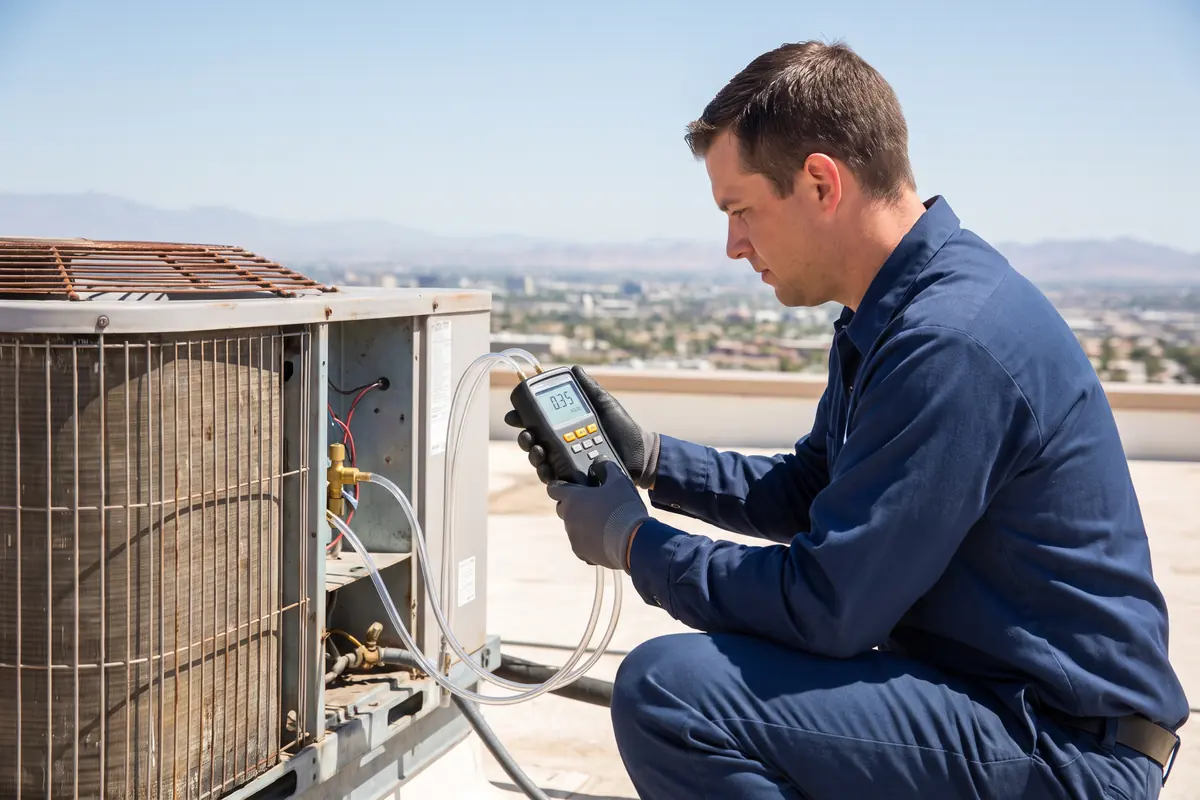
The first thing to do is not to talk about equipment. It is to put two probes in the plenum and read a number.
What total external static pressure is
Total external static pressure, or TESP, is the total resistance the blower has to overcome to move air through everything outside the equipment cabinet: the return duct, the filter, the supply plenum, the trunk, the branches, and the grilles.
You measure it with a manometer, taking a reading on the return side before the blower and one on the supply side after the coil, then adding the absolute values. It takes about ten minutes and two 3/8 in. test ports.
Most residential air handlers are rated at 0.5 in. w.c. That number is on the blower table in the installation manual, and it is the condition at which the published airflow is achieved. Go above it and airflow falls, following the blower curve.
What we actually measure
On systems installed in the last five years, we routinely read 0.9 to 1.2 in. w.c. That is not exotic; it is close to normal. It means the blower is delivering somewhere between 60 and 80 percent of its rated airflow, depending on the motor and the curve.
A PSC blower simply gives up: airflow drops, the coil gets colder, and in extreme cases it freezes. A modern ECM blower does the opposite. It ramps up to try to hit its programmed airflow, draws more power, gets louder, and in some cases still fails to get there. Either way the back bedroom is not getting its design cfm, and no thermostat setting will change that.
Split the reading
The single most useful refinement is to record the return-side and supply-side pressures separately rather than only the total. It tells you which half of the system to work on.
- Return side dominant, which is the common case in Denver's post-1990 housing stock: one central return grille, undersized return trunk, or a filter rack far too small for the media in it.
- Supply side dominant: usually a small number of very bad fittings, a plenum takeoff immediately at the discharge, or flex duct compressed in a joist bay.
- Coil and filter dominant: a one-inch high-MERV filter in a rack sized for MERV 8, or a dirty evaporator coil nobody has looked at.
Why it is usually the return
Supply ducts get designed because they are visible in the rooms people care about. Returns get what is left. A single 20 x 25 central return grille that is asked to pass 1,200 cfm is moving air at roughly 500 fpm through the free area of the grille, and paying for it in pressure drop before the air has even entered the duct.
Adding a second return path, or enlarging the existing one and correcting the filter rack, is frequently a one-day job. It costs a fraction of an equipment change and it fixes more of the complaint, because it restores the airflow the equipment was always capable of delivering.
The altitude footnote
In Denver this matters more than it does at sea level, for two reasons that push in the same direction. First, the equipment needs more actual cfm here to deliver the same capacity, because the air is thinner. Second, the fan produces about 17 percent less static pressure at our density, so it has less headroom to fight a restrictive duct with.
A duct system that would be merely mediocre at sea level can be genuinely undersized at 5,280 ft. It is the same ductwork; the margin is just gone.
What to ask for
If you are getting a quote for replacement equipment, ask three questions:
- What is the current total external static pressure, split between return and supply?
- What is the rated external static pressure of the equipment you are proposing?
- What will you do about the difference?
Any contractor who has actually measured it will answer in about fifteen seconds. Anyone who has not will change the subject to efficiency ratings.
We take the reading before quoting, on every job, and it goes in your file with the reading we take afterwards. Two numbers, before and after, are harder to argue with than any amount of description.
Written by Curtis Amankwah
Service Manager at Blueprint Mechanical. Last updated . This is a demonstration site, so the author is a character rather than a person.